


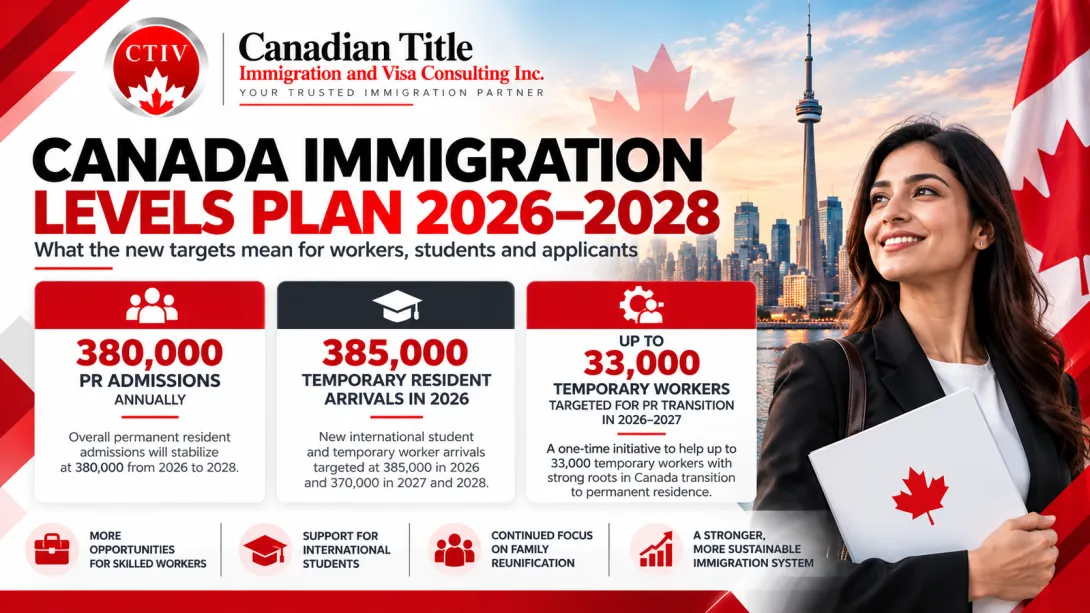
Canada Immigration Levels Plan 2026–2028: What Workers, Students and PR Applicants Need to Know
Canada is changing how it manages immigration. The federal government’s 2026–2028 Immigration Levels Plan aims to reduce pressure on housing and public services while continuing to attract skilled workers who can contribute to the Canadian economy.
For people hoping to make Canada their permanent home, the plan raises several important questions. Will permanent residence opportunities continue? Are fewer international students and temporary workers expected to arrive? And what does the proposed transition of up to 33,000 temporary workers to permanent residence mean for people already working in Canada?
The plan provides some important answers, but it is equally important to understand what it does not promise. Immigration targets are not the same as individual eligibility rules, and an announced initiative does not automatically give every temporary resident a pathway to permanent residence.
Here is a practical look at the main changes and what they could mean for your immigration plans.
Key highlights of Canada's 2026–2028 Immigration Levels Plan
The government's published plan sets the following headline targets:
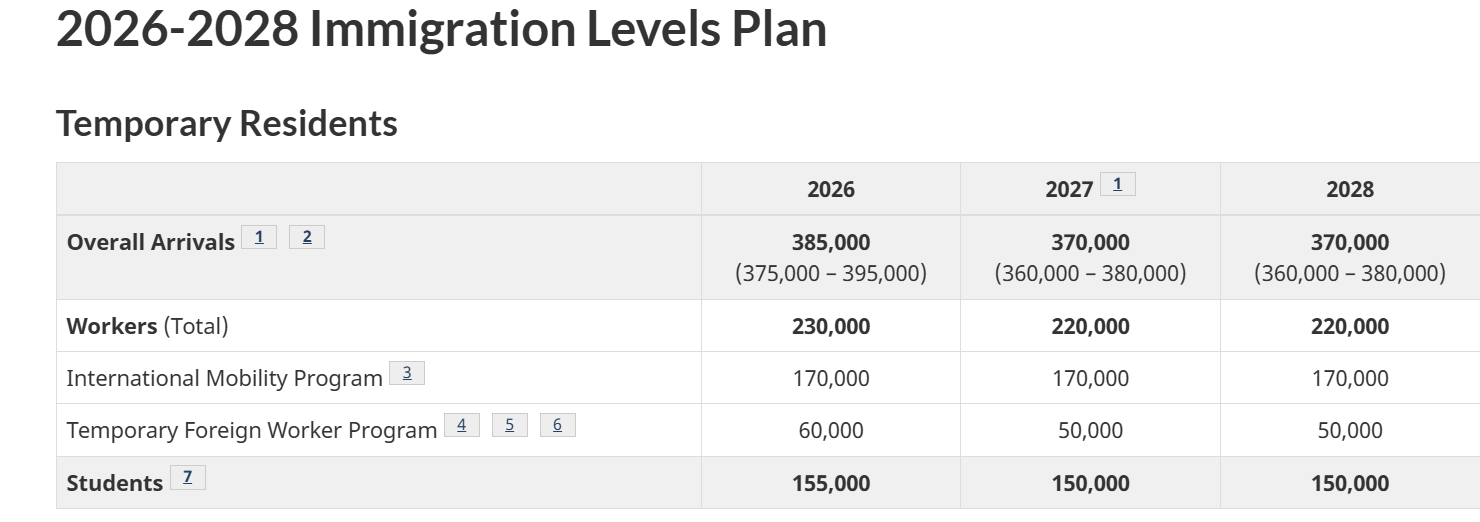
Immigration target 2026 2027 2028
Planned permanent resident admissions 380,000 380,000 380,000
Target for new temporary resident arrivals 385,000 370,000 370,000
New international student arrivals 155,000 150,000 150,000
Temporary worker arrivals — total 230,000 220,000 220,000
Temporary Foreign Worker Program arrivals 60,000 50,000 50,000
International Mobility Program arrivals 170,000 170,000 170,000
Source: Immigration, Refugees and Citizenship Canada (IRCC), Supplementary Information for the 2026–2028 Immigration Levels Plan. Temporary resident figures refer to targeted new arrivals under the specified programs, not every person holding temporary status in Canada.
One distinction matters here: Canada is not planning to reduce permanent resident admissions in the same way it is reducing targets for new temporary resident arrivals. Planned permanent resident admissions remain at 380,000 annually, while temporary resident arrival targets fall after 2026.
1. Canada plans to maintain 380,000 permanent resident admissions annually
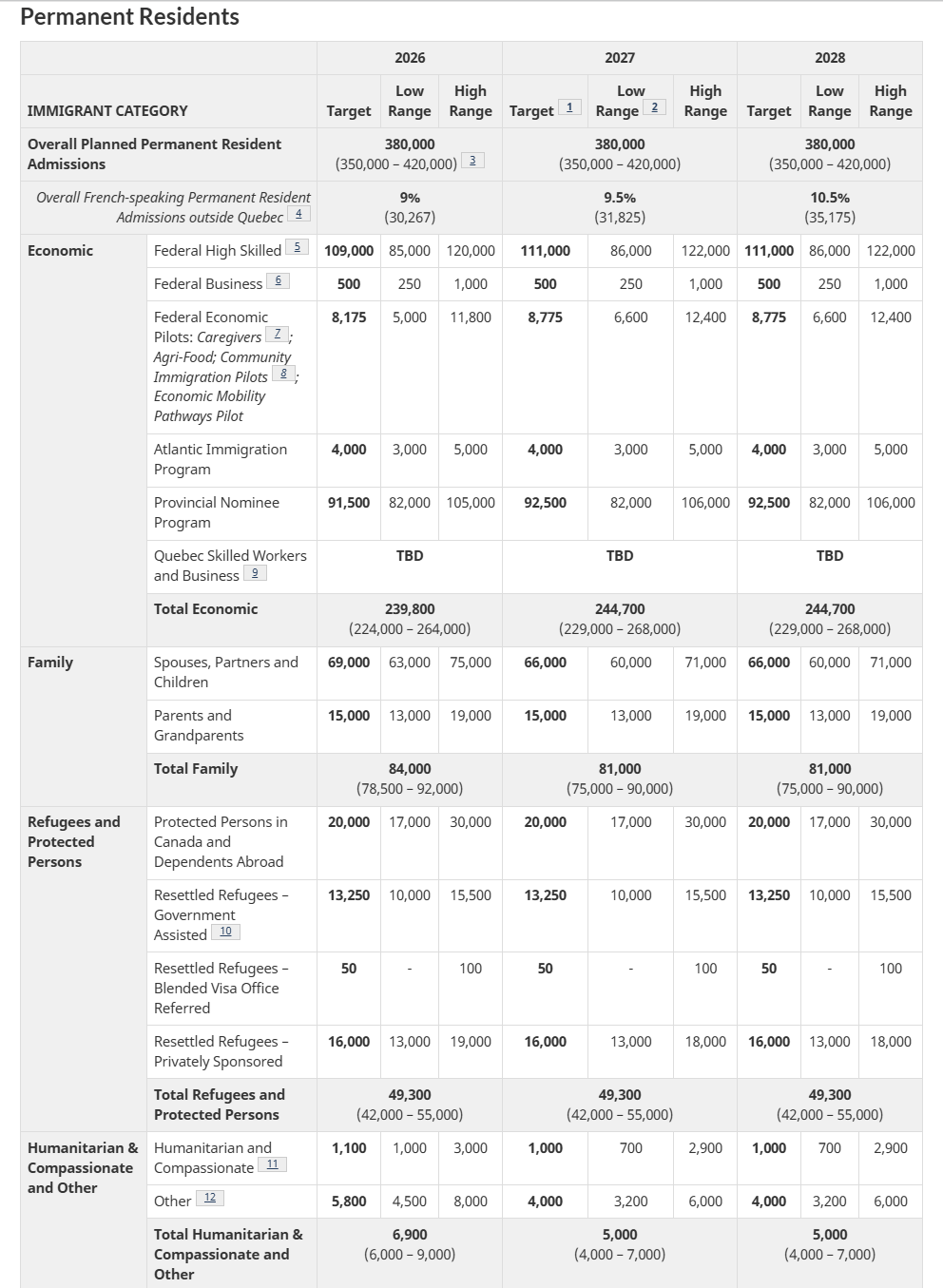
Under the plan, Canada is targeting 380,000 permanent resident admissions in each of 2026, 2027 and 2028.
This signals a move toward more stable admission levels rather than continued expansion. Economic immigration remains central to the government's approach because Canada needs workers with skills and experience that support businesses, public services and key sectors.
The economic category is projected to account for 64% of permanent resident admissions in 2027 and 2028. The plan also increases the targets for Federal High Skilled immigration and the Provincial Nominee Program compared with earlier levels.
For prospective immigrants, the message is straightforward: opportunities remain, but applicants need to focus on programs for which they qualify. The overall admission target does not tell an individual applicant whether they will receive an invitation, nomination or approval.
2. Canada is reducing new temporary resident arrivals
One of the most significant changes is the reduction in targets for new temporary residents.
The plan sets a target of 385,000 new temporary resident arrivals in 2026, falling to 370,000 in both 2027 and 2028. These targets cover new arrivals under the international student and temporary worker programs specified by the government.
The target for new international student arrivals falls from 155,000 in 2026 to 150,000 in 2027 and 2028. Temporary worker arrivals are targeted at 230,000 in 2026 and 220,000 in each of the following two years.
This policy is part of the government's commitment to reduce the temporary population to less than 5% of Canada's total population by the end of 2027.
What does this mean for international students?
Students planning to study in Canada should prepare carefully before choosing a program or institution. They should review current study permit requirements, the rules that apply to their chosen program and the conditions under which they may work during or after their studies.
Graduation does not guarantee a post-graduation work permit or permanent residence. Eligibility depends on the rules in force and the applicant's individual circumstances.
Anyone planning to use Canadian education as part of a longer-term immigration strategy should understand the full pathway before making a major financial commitment.
What does this mean for temporary foreign workers?
The government continues to recognize the role temporary workers play in meeting labour needs. However, lower arrival targets mean that applicants and employers should not assume the same volume of new temporary worker admissions will continue indefinitely.
The plan also says the government will consider the needs of certain industries affected by tariffs and the particular requirements of rural and remote communities.
For workers already in Canada, the key task is to review their existing status, employment situation and potential permanent residence options rather than assume that holding a work permit will lead to permanent residence.
3. Up to 33,000 temporary workers could transition to permanent residence
One of the most closely watched measures in the plan is a one-time initiative to accelerate the transition of up to 33,000 temporary workers to permanent residence during 2026 and 2027.
The government describes the initiative as targeting workers who have established roots in their communities, pay taxes and contribute to Canada's economy. The plan highlights in-demand sectors and rural areas with labour shortages.
For eligible workers, this announcement could be significant. It reflects a policy focus on people who are already living and working in Canada and contributing to their communities.
However, there is an important limitation: the announcement does not mean that every temporary foreign worker can apply under a new permanent residence program or is guaranteed permanent residence.
The government has described the measure as targeted. The specific eligibility rules, selection process and implementation details must be confirmed through official announcements.
Who should pay attention to this initiative?
Workers who have spent time building their careers in Canada may wish to monitor further details, especially if they work in an in-demand sector or a rural community.
In the meantime, they can review whether they qualify for existing pathways, including Express Entry programs, provincial nomination streams or other economic immigration programs. The right option depends on factors such as work experience, language ability, occupation, education, job offer requirements and the province where the applicant intends to settle.
It would be premature to assume that a particular occupation, employer or length of Canadian employment automatically qualifies someone for the 33,000-worker initiative.
4. Express Entry and skilled immigration remain important
The Immigration Levels Plan includes increased targets under Federal High Skilled immigration. This category includes the Canadian Experience Class, Federal Skilled Worker Program and Federal Skilled Trades Program.
These programs remain important options for eligible candidates seeking permanent residence through Express Entry. Each has its own requirements, and meeting a program's eligibility criteria does not guarantee an invitation to apply.
Candidates should pay attention to the factors that affect their individual profiles, including language test results, qualifying work experience, education and eligibility for category-based selection.
A provincial nomination may also be relevant for candidates who meet a province's requirements. The Provincial Nominee Program has a target of 91,500 admissions in 2026, increasing to 92,500 in 2027 and 2028, although the published operational ranges allow for variation.
For applicants, the practical approach is to assess several legitimate options rather than rely entirely on one expected Express Entry draw or one predicted CRS cut-off.
5. Family reunification remains part of Canada's immigration plan
Economic immigration receives the largest share of planned admissions, but family reunification continues to be a significant part of the system.
The plan sets a total family category target of 84,000 admissions in 2026 and 81,000 in each of 2027 and 2028. This category includes spouses, partners and children, as well as parents and grandparents.
The plan therefore does not eliminate family immigration. It continues to allocate places to family sponsorship while adjusting the overall balance among immigration categories.
Applicants should check the current requirements and intake arrangements for the specific sponsorship program they intend to use. The existence of an annual target does not guarantee that every application will be accepted or processed within a particular period.
6. Canada is increasing its focus on French-speaking immigrants outside Quebec
The plan also reinforces Canada's objective of supporting Francophone minority communities outside Quebec.
The targets for French-speaking permanent resident admissions outside Quebec are:
Year Target share Planned admissions
2026 9% 30,267
2027 9.5% 31,825
2028 10.5% 35,175
The broader government objective is to reach 12% Francophone permanent resident admissions outside Quebec by 2029.
For eligible candidates with strong French-language skills, this policy direction makes it worthwhile to investigate relevant immigration options. However, speaking French alone does not guarantee permanent residence. Candidates must still meet the requirements of the applicable program or selection category.
7. A separate initiative aims to transition approximately 115,000 protected persons
The plan includes a one-time, two-year initiative to streamline the transition to permanent residence for approximately 115,000 protected persons in Canada who are already on a pathway to permanent residence.
This measure is distinct from the temporary worker initiative. Protected persons have recognized protection status in Canada and are not temporary residents in the same sense as international students or temporary foreign workers.
The government says the initiative is intended to recognize the status of people who have been found to need protection and to support their integration into Canadian society.
It should not be interpreted as a general permanent residence pathway for all temporary residents or people whose immigration applications are pending.
8. What should you do if you want to immigrate to Canada?
The 2026–2028 plan provides a broad picture of Canada's priorities, but your next step should depend on your own circumstances.
If you are working in Canada: Review your qualifying work experience, language results and possible Express Entry or provincial pathways. Monitor official details about the 33,000-worker initiative, but do not assume eligibility before the rules are published.
If you are an international student: Review current study permit conditions, program eligibility and post-graduation options before deciding how to plan your future in Canada.
If you are applying from outside Canada: Assess your eligibility under economic immigration programs and check whether your occupation, language skills or other qualifications fit a relevant pathway.
If you speak French: Investigate the programs and selection categories available to French-speaking candidates, particularly those intended to support Francophone communities outside Quebec.
If you are sponsoring family members: Review the rules and intake arrangements for the specific family sponsorship category, as annual targets are not a guarantee of approval.
Immigration policies can change, so use the official program requirements that apply when you submit your application.
Frequently asked questions
How many permanent residents will Canada admit from 2026 to 2028?
The published Immigration Levels Plan sets a target of 380,000 permanent resident admissions for each of 2026, 2027 and 2028. The plan also includes operational ranges that provide flexibility.
Is Canada reducing immigration in 2026?
Canada is reducing targets for new temporary resident arrivals while stabilizing planned permanent resident admissions at 380,000 annually. The effects differ by immigration category and program.
Can 33,000 temporary foreign workers get permanent residence?
The government has announced a one-time initiative to accelerate the transition of up to 33,000 temporary workers to permanent residence in 2026 and 2027. This is a targeted measure, not a guarantee for every work permit holder. Workers should await the detailed eligibility and application instructions.
Will international students still be able to immigrate to Canada?
Eligible international students may still qualify for permanent residence through available pathways, but studying in Canada does not automatically lead to a work permit or permanent residence. Applicants should review the current rules before choosing a study program.
Does the plan guarantee a lower CRS score in Express Entry?
No. Immigration Levels Plan targets do not determine the CRS cut-off for an individual Express Entry draw. Draw results depend on the round type, eligible candidate pool, invitation numbers and applicable selection rules.
Where can I check the official immigration targets?
Consult IRCC's published 2026–2028 Immigration Levels Plan for the official targets and explanations.
Final thoughts: Plan your immigration pathway around your eligibility
Canada's 2026–2028 Immigration Levels Plan reflects two objectives: managing temporary resident arrivals more carefully and continuing to select permanent residents who can contribute to the economy and communities across the country.
The proposed transition of up to 33,000 temporary workers is an important announcement for people already established in Canada, but the details will matter. Meanwhile, Express Entry, provincial nomination, family sponsorship and other programs remain distinct pathways with their own requirements.
The most useful step is to understand which options fit your circumstances today, keep your documents up to date and follow official announcements before making important decisions.
Need help reviewing your Canadian immigration options?
Canadian Title Immigration and Visa Consulting Inc. (CTIV), among the best immigration consultants in Toronto, Canada, can help you review your profile and identify immigration pathways that may be suitable for your circumstances.
- Phone: 416-857-0100
- Email: info@ctivci.ca
- Website: www.ctivci.ca
This article provides general information and is not a guarantee of immigration eligibility or approval. Immigration targets, program requirements and application procedures may change. Always consult official government information for current rules.


